Methodology

Design your life, on purpose.

Intentful isn’t built on a productivity hack. It’s a coherent method for turning who you want to become into what you do this week. It’s grounded in decades of behavioral science and the Kaizen discipline of small, consistent improvement.

What “Intentful” means

To be intentful is to choose deliberately. We are doing this thing, for these reasons, with the intent of achieving that very specific result. That’s the whole idea. Intentful is a planner that helps you act with intention instead of reacting to life. The name carries that promise, and so does the tagline, the why behind every week.

Start with the end in mind

Most planning starts with the week and what’s on Monday. Intentful starts with the end. Where are you going, and why? That order isn’t a preference. It’s the whole point. A vision gives your days a direction to ladder back to, so daily busywork becomes momentum instead of motion. Direction first, then execution.

From the Vision Board, the path is deliberate. You break a vision into a handful of milestones, let those milestones shape your weekly goals, and turn your weekly goals into the two or three things you actually do today. AI can draft the milestones for you and your Coach can help at every step, but you own every decision.

The spine of the method

Kaizen means change for the better.

If starting with the end sets your direction, Kaizen (改善) is the discipline that gets you there. Born in postwar Japanese manufacturing and refined in Toyota’s Production System, Kaizen rejects dramatic overnight transformation in favor of something quieter and far more durable. Small, consistent, deliberate improvements, made every single day.

The math is unforgiving in the best way. Get 1% better each day and you compound to roughly 37× better over a year. Slip 1% a day and you erode to almost nothing. The only difference between those two lives is the daily practice, and that’s exactly what Intentful is built to hold.

Kaizen is the thread that ties the whole method together. It doesn’t replace the science behind implementation intentions, habit formation, deliberate reflection and gratitude. It gives those practices one shape. Small steps, taken consistently, toward a clear end.

And it isn’t only built into the layout. It’s how your AI Coach thinks. The coach never hands you a dramatic overhaul. It reads what actually happened last week, then suggests the next small, concrete step and waits for your yes. It works in weekly cycles of plan, do, check and adjust, and tunes your plan a little at a time as life changes. Every suggestion is a 1% move you can approve or decline, never a rewrite of your life. Kaizen isn’t just the philosophy on the page. It’s how the coach helps you.

“We are what we repeatedly do. Excellence, then, is not an act, but a habit.”Will Durant, summing up Aristotle
Pillar 01

Housekeeping

Order first. A place for everything, from your vision to your week, your day and your projects, so nothing clutters your attention. Intentful keeps the system tidy and unfinished tasks carry forward, instead of living in your head. In Japanese practice this is called 5S, which stands for sort, set in order, shine, standardize and sustain.

Pillar 02

Eliminate waste

Cut the time, attention, and energy spent on what doesn’t move you forward. In Kaizen, this is called muda. The daily ritual clears decision fatigue before the day can spend it for you.

Pillar 03

Standardize what works

Turn your best days into your baseline. One small habit, tracked until it’s automatic, becomes the floor you build the next improvement on.

Together these three pillars serve one goal, continuous improvement. Each week is a full loop of plan, do, check and adjust, with hansei (反省), or honest reflection, built into the review.

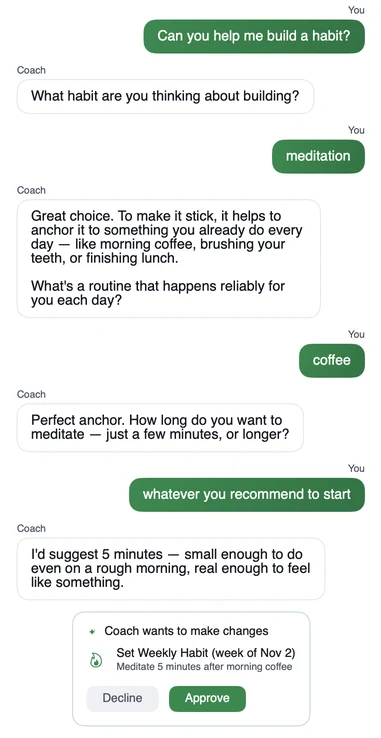
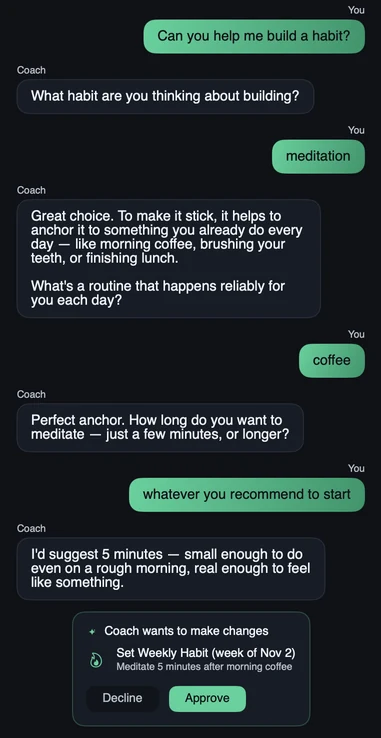
AI Coach helping build a habit: start small and tie it to morning coffee AI Coach helping build a habit: start small and tie it to morning coffee
Small steps, in practiceAsk the Coach to help you build a habit. It starts with something small enough to do on your worst day and ties it to something you already do, like your morning coffee. Nothing changes until you approve it.

Two registers: what gets measured, and what gets felt

Intentful tracks progress on two levels at once. The measurable layer is everything you can count, like habits completed, goals closed, priorities finished and streaks. You see it in Stats, and the Coach uses it too. Underneath it sits a discipline most people know by name but rarely apply. SMART goals are Specific, Measurable, Achievable, Relevant and Time-bound. Intentful never lectures you about it or labels a “SMART goal.” It builds the criteria into the structure. A weekly goal you can tick off is Measurable, and a week that ends on Sunday is Time-bound. The Coach quietly applies the same rigor when it helps you sharpen something vague.

The felt layer is everything noticed rather than counted: what you were grateful for, what you’re looking forward to, the wins you saw and why they mattered. None of it is scored or ranked, and that’s on purpose. Its value is in the attention, not the tally. Naming what you’re grateful for and what you’re looking forward to isn’t decoration. Gratitude tunes your attention toward the good that’s already here and anticipation toward the good that’s coming, and that steady orientation toward the positive is what keeps the whole system feeling like momentum rather than obligation. A system that measures without meaning becomes a joyless scoreboard. A system with meaning but no measurement becomes comfortable drift. Intentful holds both, because where attention goes, intention follows.

The science

Built on proven methods.

Every practice in Intentful earns its place on the research. A few of the ideas underneath it:

Start with the end in mind

Define the destination before you fill in the schedule. A clear picture of where you’re going is what turns daily work into momentum instead of just busyness.

The research →

Start with the end in mind

Stephen Covey, The 7 Habits of Highly Effective People (1989), Habit 2: “Begin with the end in mind.” Intentful builds it in. The app opens on your Vision Board, not the weekly page.

← Back

Kaizen · 1% better

Small, consistent, deliberate improvement. Steady beats heroic. Get 1% better each day and you compound to roughly 37× over a year.

The research →

Kaizen · 1% better

Kaizen (改善, “change for the better”) is the continuous improvement discipline from Toyota’s Production System. Masaaki Imai, Kaizen (1986).

← Back

Implementation intentions

Specific “when X, I’ll do Y” plans make you far more likely to follow through than vague goals do. Getting specific is the lever.

The research →

Implementation intentions

Peter Gollwitzer, “Implementation Intentions” (American Psychologist, 1999). Plans in the form “if this happens, I’ll do that” make people 2 to 3 times more likely to follow through than general goals.

← Back

Vision & obstacles (WOOP)

Vivid outcomes paired with an honest look at the obstacles beat positive thinking alone. Vision without a plan is fantasy.

The research →

Vision & obstacles (WOOP)

WOOP stands for Wish, Outcome, Obstacle and Plan. It’s Gabriele Oettingen’s mental contrasting method. Rethinking Positive Thinking (2014).

← Back

Tiny habits

One habit, anchored to a routine you already have, beats tracking eight at once. That’s why Intentful’s daily habit field is singular by design.

The research →

Tiny habits

BJ Fogg, Tiny Habits (2019); James Clear, Atomic Habits (2018). A new behavior takes about 66 days to become automatic, according to Lally et al. (2010).

← Back

Deep work

If you don’t defend time for what matters, reactive work fills all of it. Blocking time protects the important from the urgent.

The research →

Deep work

Cal Newport, Deep Work (2016). Intentful’s weekly schedule syncs both ways with Apple Calendar so you can block priorities first.

← Back

Gratitude & reflection

Gratitude reliably lifts wellbeing, and a few honest minutes of daily reflection measurably sharpen performance.

The research →

Gratitude & reflection

Emmons & McCullough (2003) on gratitude. Di Stefano et al. (2016) found that 15 minutes of daily reflection improved performance by 23%. The Japanese practice hansei (反省), “deep reflection,” is core to Kaizen.

← Back

Anticipation

Looking forward to something good produces more sustained happiness than the event itself. It gives you something to hold onto on hard days.

The research →

Anticipation

Gilovich & Kumar, “We’ll Always Have Paris” (Advances in Experimental Social Psychology, 2015).

← Back

Self-efficacy from wins

Noticing what went well, and why, builds the belief that your effort produces results. That belief is the fuel ambitious goals run on.

The research →

Self-efficacy from wins

Martin Seligman et al. (2005) found lasting increases in happiness from the “three good things” practice.

← Back

Hover or tap any card to see the research behind it.

Gratitude & anticipation

Notice what’s good. It changes what you notice next.

Intentful gives gratitude and “looking forward to” real estate on purpose. Gratitude, written with enough specificity to actually feel it, reliably lifts wellbeing and trains you to see what’s working, which you need before you can improve it. Anticipating something positive generates more sustained happiness than the event itself, and gives you an anchor to reach for on the hard days. Neither is scored. The value is in the attention.

The most important project you’ll ever work on.

After 90 days of consistent use, you’ll have an honest record of what you did, what worked, and who you were becoming.